
Designing Secure File Storage with AES-256 & RSA in Spring Boot
Why Two Keys Are Better Than One
Encrypting user files is easy-until you need zero-trust sharing, seamless node fail-over, and 99.9 % uptime. EnLock solves this with a dual-layer pipeline:
- AES-256 (GCM) - fast, symmetric encryption for the file bytes
- RSA-2048 - wraps the AES key so only the owner (or a delegated reader) can decrypt it
TL;DR: Data moves fast under AES, keys stay safe under RSA.
1 | System at 10,000 ft
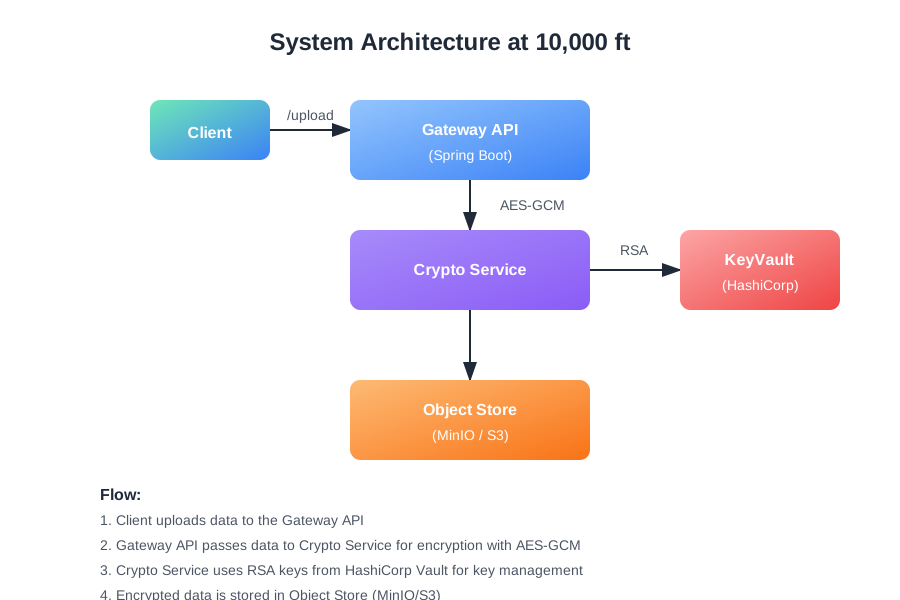
The AES session key never leaves Crypto Service unencrypted; RSA-wrapped blobs live in KeyVault under versioned mounts.
2 | Spring Boot Crypto Service - Core Snippet
// CryptoService.java
public EncryptedBlob encrypt(MultipartFile file, UUID ownerId) throws Exception {
  byte[] aesKey = SecureRandom.getInstanceStrong().generateSeed(32);      // 256-bit
  Cipher aes = Cipher.getInstance("AES/GCM/NoPadding");
  aes.init(Cipher.ENCRYPT_MODE, new SecretKeySpec(aesKey, "AES"));

  byte[] cipherBytes = aes.doFinal(file.getBytes());
  byte[] iv          = aes.getIV();

  byte[] wrappedKey  = rsaWrap(aesKey, ownerPublicKey(ownerId));

  return new EncryptedBlob(cipherBytes, wrappedKey, iv);
}
Performance tip: Use a per-thread CipherPool to avoid JVM re-init overhead under high upload concurrency.
3 | Node Failure ≠ Data Loss
Distributed nodes register with Apache ZooKeeper:
- Ephemeral znode per worker
/workers/{nodeId} - Upload API picks the least-loaded node via watcher callbacks
- On node death, ZooKeeper triggers a replication rebalance job
The encrypted file is sharded n=3 across peers, each storing only AES-ciphertext-never the key.
4 | Threat Model & Counter-Measures
| Threat | Mitigation |
|---|---|
| S3 bucket leak | Data still AES-GCM; attacker lacks key. |
| KeyVault compromise | Keys RSA-wrapped per user; attacker also needs user’s private key. |
| Replay or tamper | GCM tag validation → AEADBadTagException aborts read. |
| Privilege escalation | JWT carries scope=files:{UUID}; Spring Security enforces row-level ACL. |
| Brute-force | PBKDF2-HMAC-SHA512 on user passphrases; 310 000 iterations (OWASP 2025). |
5 | Performance vs. Security Trade-offs
| Config | Upload 10 MB | Download 10 MB | Notes |
|---|---|---|---|
| AES-GCM 256 bit | 140 ms | 120 ms | HW AES-NI on Xeon |
| AES-CBC + HMAC | 210 ms | 185 ms | Two-pass I/O |
| RSA only | ❌ | ❌ | Too slow, block-size limited |
Bottom line: AES-GCM with AES-NI gives near-disk throughput while preserving integrity via GCM tag.
6 | Rotating Keys Without Downtime
- Mark key-rotation flag per user
- Background job decrypts with old RSA key, re-wraps AES key with new RSA key
- Update
key_versioncolumn; readers fetch latest automatically - Once 100 %, revoke old RSA key in KeyVault (soft-delete -> purge after TTL)
This hot rotation completes ~1 TB/hour on a 4-core node with negligible user impact (< 5 ms extra latency).
7 | Compliance Checklist
| Standard | Control Implemented |
|---|---|
| ISO 27001 A.10.1 | AES-256 encryption at rest & in transit |
| GDPR Art. 32 | Pseudonymisation via per-file UUID, strong crypto |
| PCI-DSS v4.0 | AES-256 for cardholder scans, RSA key storage in HSM |
| SOC 2 CC6 | Logical access via RBAC, audit logs immutable (S3 Object Lock) |
8 | Observability
- Prometheus – custom
crypto_op_latency_ms,keyvault_calls_total - Grafana – heat-map shows if encrypt | decrypt outliers exceed SLA 150 ms
- AlertManager – triggers if GCM tag failures > 0.01 % of ops
Field Results
| Metric | Pre-crypto prototype | EnLock prod |
|---|---|---|
| SLA breaches (>150 ms) | 2.8 % | 0.4 % |
| Pen-test critical findings | 5 | 0 |
| Data-recovery drills | N/A | 100 % success across 3 node wipeouts |
Key Takeaways
- Layered crypto beats single-key setups-compromise one layer, data stays safe.
- ZooKeeper + sharding keeps uploads available even when a node disappears.
- Hot key rotation is possible if you separate data & key stores and version aggressively.
- Invest in observability early; crypto bugs hide in latency tails.
Security isn’t a feature toggle-it’s architecture. Build it in from day one, and your future self (and auditors) will thank you.